The Caribbean offers travelers a seemingly endless variety of experiences. One of the most magical is snorkeling or diving the Underwater Sculpture Park in Grenada’s Molinere Bay. The park was designed in 2007 by British sculptor Jason deCaires Taylor, who later created similar installations around the world. The Underwater Sculpture Park in Grenada has been listed as one of the Top 25 Wonders of the World by National Geographic.
Taylor’s objective wasn’t only artistic. He intended the sculpture to contribute to the environmental sustainability of the bay by offering a habitat for marine life, including corals, algae and sponges. The sculptures may have begun their life a single gray color, but over the years became a melange of pinks, greens, yellows and black. One of the delights of exploring the park is seeing the transformation of the sculptures as well as fish darting in and around them.
The life-size sculptures range from whimsical figures, such as a bicycle rider and a man sitting at a desk tapping away at a typewriter, to more poetic installations, including the female figures of “Grace Reef” who are at times hidden by the sand and then revealed again by the tides.
For me, one of the most emotionally impactful installations is a ring of life-size figures holding hands, titled “Vicissitudes.” The figures represent Grenadian schoolchildren and are now multicolored and covered with barnacles — thus making the vision more affecting than when first installed. It’s a wonderful example of how Taylor has encouraged his work to become part of the environment.
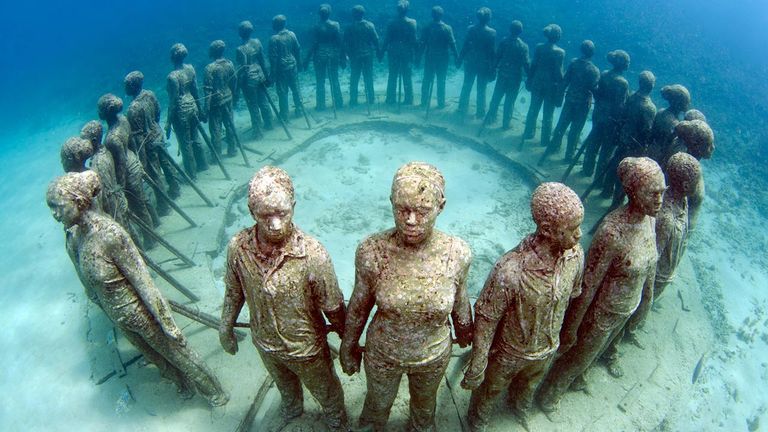 Life-size figures are part of an installation called “Vicissitudes.”
Credit: 2020 Orlando K. RomainGetting to the Underwater Sculpture Park
The Underwater Sculpture Park is accessed via boat in guided tours offered by several on-island tour operators. I’ve been lucky enough to experience the Underwater Park twice during my visits to Grenada; I have snorkeled above the figures, and even at that distance they were a stirring sight. Scuba divers will have the additional experience of getting up close to the figures, which enables an intimate look at the changes wrought by time and the sea. For those who don’t want to get wet, there’s the option of glass-bottom boat tours.
My first visit to the park, 10 years ago, was with Grenada Seafaris Powerboat Eco-Tour and onboard its 12-passenger Seafari Explorer. This was an adrenaline-fueled ride at high speeds. The excitement of the boat ride provided a nice contrast to the slow-moving, guided snorkeling adventure where we glided above the sculptures.
The second visit, which took place only a few months ago, was via a boat trip organized by Island Routes Caribbean Adventures. I was staying at Sandals Grenada and enjoyed the convenience of boarding the vessel from the resort’s dock. This was a mellower excursion than the powerboat tour; we soaked up the sun and the salty air, sipped cocktails and listened to soca music on the boat’s stereo. I also loved the chance to view the island’s capital city, St. George’s, from the sea.
More recently, additional artists have contributed work — 14 new sculptures that blend well with Taylor’s original pieces. These include “The Silent Cry” by Rene Froehlich, a stirring depiction of a female figure wrapped in the roots of a tree; and a selection of Amerindian sculptures inspired by ancient Amerindian art by Troy Lewis.
The Details
Grenada Seafaris Powerboat Eco-Tours
www.grenadaseafaris.com
Grenada Tourism Authority
www.grenadagrenadines.com
